Wednesday, October 16, 2013

ROOTS - not the movie - 7

     We start another day in Denmark. After a healthy breakfast we are off again, but this time we are going somewhere else. We are going to see Jungshoved Kirke (Jungshoved Church) where I was confirmed; we are going to see the last public school I attended, Jungshoved Skole; we are going to see the last place I lived in as a child before going to sea and we are going to see an old friend from school, and so on ....

      First we drive to Jungshoved Kirke and find it looking as it did when I was 14 / 15 years old. The attached link has quite a bit about the history and the architecture of the church, although the English is not the best and there are a few other links.
http://thyrashm.blogspot.com/2013/09/jungshoved-church-jungshoved-kirke.html
http://www.bing.com/images/search?q=jungshoved+kirke&qpvt=jungshoved+kirke&FORM=IGRE
http://www.flickr.com/photos/vivede/2650262434/in/photostream/
http://www.tageo.com/index-e-da-v-12-d-m3809238.htm

Jungshoved Kirke with the graveyard surrounding it.
     This is the church in which I was confirmed together with my brother Max and our friends from school. Each Saturday for what seemed like an eternity we would have to go to the Praeste Gaard (The priests farm) for catechism classes. Since I was a Lutheran at the time we were taught Luther's Little Catechism so we could recite it in our sleep. For the Catholics out there, of which I am one now, this catechism was similar in structure and context to the Baltimore Catechism; that is to say we learned stock replies to stock questions, we just didn't learn the why of the answer.
      At the time of our confirmation we joked about how narrow the aisle in the nave was, and at that time pointed shoes were the in style (1960) and we were wondering if the aisle would be wide enough for us to turn around when it was time to leave the church. I know I have a group photo somewhere of the confirmation class but can't seem to find it; if I do, it will be posted here. Here are some photos from the inside of the church.
The Altar with a menorah and the motif of the "Last Supper"
 
 The pulpit - (Praedike Stolen) - the preaching "chair".
Norma is not preaching to me, she is posing.
 The pulpit with its beautiful woodcarvings, depicting the Evangelists
in this case Saint Matthew.
 Saint Mark
 Saint Lucas
Saint John
    
      Just outside of the church grounds and grave yard is a little hill and a moat. This was once the defenses of a large manor house called Jungshoved Castle, which is a bit misleading. It was apparently the source of defense of a fairly large section of that part of the country when raider would come in the cove from Sweden, but the defenses were also to keep the local citizens at bay, who at that time were serfs, which was much worse than being a share cropper or slave.
The cove outside the hill and moat, full of swans,
the National Bird of Denmark.
Is it a Swedish raiding party in the boat out on the water?

Someone enjoying lunch at a picnic table.
Norma by the information post and the Church and Praestegaard in the background.
 
     One of my memories from this hill is the celebration of Midsummer Fest, which is a big deal in Denmark, which is always celebrated on the Summer Solstice, the longest day of the year and in Christian terms in honor of Saint Hans. Large bonfires are built and a witch is burned in effigy, a fair amount of beer is consumed while people picnic on the grounds. I was not able to find a direct link to the celebration at this location, but found a link for the same celebration in Skagen.

http://www.visitdenmark.nl/nl/denmark/midsummer-fest---sankt-hans-gdk640849
http://goscandinavia.about.com/od/annualeventstraditions/a/midsummerseve.htm

     We drive to the little village of Stenstrup and find that there is nobody home in the old farmhouse mom and dad rented before they built a house in Praestoe (Præstø), which by the way, if translated literally means "Priest Island".  Well, let us walk to the farm next door and see if there is anybody home there, the home Egon and Eleanor (their last name escapes me) and their 3 children, (2 boys and 1 girl). The children were a bit younger than I but we were good friends.
     When we entered the yard we found a little Vietnamese girl, about 5 or 6, playing. That was for some odd reason a bit surprising. We asked her, in Danish, if her parents were home and she said yes, her father was home and she calls in the door for him to come out. A man comes, looking just like his father did, and there is no doubt in my mind, so I say "You are Michael", and he said, yes I am. This is 2007 and I had not seen him since he was a little boy, in 1961, so a period of 46 years had passed. We talked about when we were children. He told me that his parents had both gone to their eternal rest. He had spent quite a bit of time in Vietnam and married a Vietnamese woman and brought her to Denmark where she learned Danish. Michael inherited the farm from his parents, but do not farm. All the land is leased out and all the animals are gone. He has his own business specializing in central heating.
Michael and his daughter who appears to be a bit shy.
 
     After visiting with Michael for a bit we take off for Jungshoved By, which is a stretch of the imagination. Jungshoved is another small village, but it did or does have a grocery store and did have a school. The school no longer functions as a public school but is used for the area population to take courses of enrichment. The links are in Danish so you will have to use Google or similar translater to figure out what is being said. Again we didn't take any pictures but did have one humorous incident.
We stopped at the little grocery store for some Danish Licorice (salmiak pastiller, salmiak staenger, piratos) http://www.nordiskimport.com/category/Licorice-and-Candy-3   and when it was time to pay I said to the young person at the counter, who could not be more than say 20 years old, "You keep remodeling this place and it is hard to find one's way around in here". He gave me kind of a "blank look" and said "What do you mean?", I replied, "When I was here last, in 1962, (way before this kid was born) the entrance was over there!"
 
     Off to Praestoe (Præstø), the small city, but nevertheless a city, through the little villages of Oen (Island) Smidstrup and Lundegaarde. I always rode my bike this route when I worked at Nielsen d.y and efterfoelger, a true hardware which was almost at the corner of Adelgade and Torvegade. Right on the corner was a grocery store. Præstø is where my parents built a house after I went to sea, a house I got to visit a total of 5 times between what would have been early 1963 and 1989. After my mother died and my father could not longer care for himself the house was sold. I was tempted to go and knock on the door but decided not to, since the people now living there would probably say "Who?" when I told who I was. I regret that I didn't take any pictures, but then that house was never really home to me, it was the place where my parents and two younger brothers lived.
     We toured the town, including the cemetery where my parents ashes are, main street, the hardware store where I had a job after school for one year, and my favorite place, the little harbor. Again, we must have been unfocused because there are no pictures. At the little harbor we saw a nice 40 or so foot long sailboat from Vancouver, British Columbia, Canada and a couple sitting in the cockpit. I asked them, kind of jokingly if they had perhaps made a wrong turn to the right coming out of the Panama Canal and they laughed and said yes. He was Canadian but his wife was from a small town just outside of Præstø. Here are a few links to information about Præstø.

http://en.wikipedia.org/wiki/Pr%C3%A6st%C3%B8
http://www.maplandia.com/denmark/storstrom/prasto/praesto/
http://www.visitmoen.com/ln-int/denmark/praesto-kirke-gdk615873
http://www.panoramio.com/photo/3518259
Præstø is also know as Gøngernes By - the City of the Gønger, which was a group of Danish rebels that defended the eastern coast of Denmark against raiders from Sweden. Their chief was from Præstø.

     Now it is time to go along the coast of Praestoe fjord http://da.wikipedia.org/wiki/Pr%C3%A6st%C3%B8_Fjord and have a quick look at Nysø Slot (Castle). http://www.panoramio.com/photo/64579899
http://commons.wikimedia.org/wiki/Category:Nys%C3%B8_(Pr%C3%A6st%C3%B8_Sogn)
Since we also drove by Lindersvold, which in my young age was a convalescent home for boys, and I was there twice, receiving all of its funding from the sale of Easter Seals, http://www.panoramio.com/photo/11146738  (in the photo on the link is the mainbuilding. To the right of entrance door was the apartment of the Headmaster, his wife and two lovely daughters. To the left was the large dining room. Upstairs were dormitories for the boys. In the wing to the left were classrooms and teacher apartments.) Later it became a school for troubled children of broken marriages, and now I do not know what it is.

     Those two stops out of the way we have to look at Vindbyholt Kro (Vindbyholt Inn) in the village of the same name, not including Kro. The earliest written reference to the village appears to be in 1387. The inn received its royal charter 1584 (almost 200 years before the American Colonies declared independence). It burned a number of times and was rebuilt in the original style. From what I can gather on the internet is that it is now closed and the buildings were sold at auction. With the kro gone a piece of Danish history is gone.
http://www.evas-postkort.dk/Faxe?ElmPhotoID=480560
      And now on to Faxe, the city of my birth and the home of a old friend from school,  Bent and his wife Anne. Bent and I became good friends and have remained in semi contact over the years. He was one  year ahead of me in school and completed school earlier but started working on a farm very near to where we lived so we kept up the contact. For the young people reading this post you have to remember this was long before cell phones, the internet, facebook, twitter, and other social media. In the village of Bregninge where I grew up there were probably less than ten homes with telephones; the carpenter shop had a phone, the school had a phone, the grocery coop had a phone, the kobmand forretning had a phone, the butcher shop had a phone, and a few of the farms. So in order to reach someone it was by mail or by, in my case, getting on the bicycle, to go see them. Later Bent went to work as an apprentice to learn the baking trade, but said he couldn't handle the flour dust and was tempted to eat his wages in the Danish pastry that was being made. Eventually he went to work for and retired from Faxe Bryggeri (Faxe Brewery).
http://en.wikipedia.org/wiki/Faxe_Bryggeri  http://www.bing.com/images/search?q=faxe+bryggeri&qpvt=faxe+bryggeri&FORM=IGRE
http://www.royalunibrew.com/Default.aspx?ID=222
Bent claims that he was never tempted to drink his wages in the good beer being brewed but didn't mind the discounts being offered to the employees.
     Over the years we would correspond from time to time, and each time I returned to Denmark we would make met just to catch up. In 1975, in 1989 and now in 2007. We find the house and have a great time just talking and once again catching up.

     First a few links to Faxe, also spelled Fakse, is a very old town. The name means "horse mane" in Old Norse. I know there is a very old school building in Faxe, dating to sometime in the early to mid 1500's but I can't find link to it.
http://en.wikipedia.org/wiki/Fakse
http://en.wikipedia.org/wiki/Faxe_Church

     Then it is off together to sightsee; first to Faxe Kalkbrud, a very large limestone quarry, which I only saw once as a child on a school trip.
http://www.youtube.com/watch?v=l1atiY58FeE
http://www.flickr.com/photos/37257005@N07/3435639764/in/photostream/
https://www.facebook.com/media/set/?set=a.321544274585479.76424.250685108338063&type=3
Norma at one of the " blue lagoons" that resulted with groundwater
seeping into the quarry pits.
 
    From Faxe Kalkbrud we are off to Stevns Klint which is a cliff on the Baltic with a church, or the remains of a church, at the edge. A large piece of the church plunged into the Baltic in 1928 when a piece of the cliff collapsed.


http://www.bing.com/images/search?q=stevns+klint&qpvt=stevns+klint&FORM=IGRE
http://en.wikipedia.org/wiki/Stevns_Municipality
http://www.flickr.com/photos/fremsley/1196745054/in/photostream/
http://www.bing.com/images/search?q=stevns+klint+kirke&qpvt=stevns+klint+kirke&FORM=IGRE
http://www.flickr.com/photos/clairepearse/8502875783/
The link below this line has some before and after photos.
http://www.bibliotek.stevns.dk/Kulturliv/Det-store-skred-paa-Stevns-Klint-fredag-den-16-marts-1928/Billeder-af-Hoejerup-Kirke-foer-og-efter-det-store-skred.aspx
Here are our photos from the same location;
The "balcony" to the right is out over the cliff.
What fell down the cliffs during the collapse was
the sanctuary area.
We are enjoying the view in what used to be the sanctuary.

The rescued remains of the altar piece.

The upper portion of the altar piece.

The hymn on the day that the end of the church fell down the cliffs.

Mosaics or wall decorations from the Catholic period.

The nave of the church looking out into space.
Notice the curve worn in the floor over the centuries.
The intricately carved entrance door.

Again the curve worn into the stone floor.
The steps leading to the bottom of Stevns Klint.
The end of the church building right on the edge.
Anne, Norma and Bent on the step of Stevns Klint.

Norma looking out over the Baltic.

At the waters edge at Stevns Klint.
 
     Once again it is late in the day and we should go somewhere for dinner and of course we do.
A neat little restaurant I can't remember where but the view is fantastic; one can see Sweden and the bridge that goes to Sweden, so I am going out on a limb here and say that it must have been "Restaurant Udsigten" (Restaurant the View) located at Kystvejen 238, Stroeby 4671, Denmark, but I could be wrong.
 
 The food is superb as is the beer, the Danes are as good as the Germans when it comes to beer making. The company is the greatest.
Bent and Anne

Yours truly and Norma

After dinner in the court yard of the restaurant.
 
 
     The time has come to head back to Frank and Lone's house, and we are worried that they may be thinking we are only using their house as a "pit stop", a place to sleep and hang our clothes. Since the last few days have been very busy we have to do nothing tomorrow and spend the day with them.
 
Another fantastic day has come to a close. More to follow in the next post.


Friday, September 27, 2013

ROOTS - not the movie - 6

      The second full day in Denmark came to an end, it was very good, the sun set, "the third day".
A late evening sunset in June 2007 in Denmark.
     Today is going to be just about as busy as yesterday. We are going to visit the little village where one of my aunts, my mothers sister, and her husband and two children lived, we are going to a town where we used to go on school field trips as well as the village where we lived for a while and from where I have my first conscious memories. We are also going to see if we can find my God Parents, now well up in years. We will go by my maternal grandparents old house and other places where I spent time as a child.

     After a good breakfast the Toyota is cranked up and off we go. First to the tiny village of Petersvaerft (Petersværft) which means Peters Wharf - http://www.visitdenmark.nl/nl/denmark/petersvaerft-gdk615123
Here my aunt lived with her husband, and I can't remember his name, and their twin sons. My uncle was a game warden and caretaker for Peter's Gaard (Peter's Farm) except this place is no little farm as measured in Denmark; 450 hectares / 1112 acres of farmland and 1050 hectares /  2595 acres of forest. http://www.darlington.dk/page215.html - http://www.vordingborg.dk/Everest/Publications/Afdelinger/Institution%20Lokalarkiverne/20090428100736/CurrentVersion/Petersgaard.pdf
Most of the links I find are in Danish so you will have to use Google Translate to get the text in English.

     While on summer vacations at my maternal grandparents house which was only a few kilometers away my brother Max and I would spend a lot of time at Petersværft, mostly because Ulvsund (Wolf Sound) was right there, and my uncle had a nice rowboat which we would row in the sound and sometimes borrowing my aunts sheets, we would row up wind and sail downwind. The forest was full of wild life, deer, rabbits, birds and it was truly a place for boys to explore. In addition, the bike ride from "mormor and morfars" house was a treat - the last bit of road was rather steeply down hill with a series of "steps" and one can build up considerable speed before getting to the bottom and a hard left turn.  If you go to google earth and zoom in on 54 deg. 58 min 14.39 secs N and 12 deg. 04 min 30.00 sec. E and you will see Petersværft, including the road and the pier or wharf. My aunt lived in the house right on the corner.

       Here are a few photos from the area.
In this building a lot of the wood used on the sailing ships built at
 in Petersværft the late 1700's and into the 1800's began to take shape here.
 A typical house in Petersværft. My childhood home looked like this
before the present owner removed the walls and replaced them with brick.
 Norma wondering if we could buy something like this?
An absolutely idyllic setting.
What peace there is in small places like this.
 

       Now it is off to Vordingborg, a city of some size, by Danish standards, with a population of not quite 12,000 in the city but about 46,000 in the general area.
http://en.wikipedia.org/wiki/Vordingborg,_Denmark  -  http://www.britannica.com/EBchecked/topic/632857/Vordingborg
http://en.wikipedia.org/wiki/Vordingborg
The city is old and is the home of Vordingborg Castle (ruins) and the Goose Tower (Gåsetårnet) which was a field trip from time to time from Horbelev Skole. We enjoyed the time here, not so much for the history but for a day away from school and a time to explore and play around. Therefore Norma had to see this very old piece of important Danish history. http://en.wikipedia.org/wiki/Vordingborg_Castle

       What remains of the old "Vording Borg" is a large hill, some of the moat, a few ruins of walls and the famous Goose Tower http://da.wikipedia.org/wiki/G%C3%A5set%C3%A5rnet
http://www.360cities.net/image/goose-tower#224.60,-3.30,55.3
http://www.visitmoen.com/ln-int/denmark/gasetarnet-gdk615135
There are many legends and stories about the Goose Tower, the golden goose on top of the tower and the attempts to steal it, including by the Nazi's during WWII. The goose is now made out of another metal and is not nearly as desirable. The grounds of the old fortress also holds a botanical garden.
A short walk across the grass of the fortress one finds Vor Frue Kirke (The Church of Our Lady), meaning the church dedicated to the Mary, the mother of Jesus, the Theotokos. This church was completed about 1460, during what in Denmark is "politically correct" called the Catholic period, since the Protestant period didn't officially begin until 1536 when the King of Denmark established the Church of Denmark, just as a famous character established the Church of England. Originally the Church of Denmark was Catholic in all but obedience to the Roman Pontiff, but that changed with influx of the teachings of Martin Luther, and the country slowly but surely became Lutheran or as Danes say, protestant.
http://www.vordingborgkirke.dk/
http://www.bing.com/images/search?q=vor+frue+kirke+vordingborg&qpvt=vor+frue+kirke+vordingborg&FORM=IGRE
http://www.vordingborgkirke.dk/vor-frue-kirke/

      Here are our photos from Vordingborg fortress, Goose Tower and the church.
 Gaasetaarnet (Goose Tower) in the background.
 Norma resting on a section of the old wall,
about 654 years old the day the photo was taken.
 The view out of one of the windows of the tower,
note the steep ground and the moat in the center.
The walls of the tower are immensely strong,
just look how thick they are.
The tower viewed from the "attackers" point of view,
from outside the moat.
 

Inside Vor Frue Kirke. Note the separation of the
sacred from the profane, which has been maintained.
 
      It is time for us to see if we can find where my godparents live. I have not seen them since 1989 and then they were living in their own home, now they are in a small apartment somewhere in the town. They don't know we are coming because we didn't have a telephone number. As luck would have it we found them and were invited in for coffee and some refreshments. We had a good couple of hours with conversation about the old days. After I went to sea they would always come to my parents house on my birthday and the day would be celebrated in my absence. Both have gone to their eternal rewards, Inge a few years ago and Anselm last year so I am glad I got to see them both.
Anselm, my godfather, to the left and Inge, my godmother, in the middle and
yours truly to the right. The scary part is that they do not look much older than I do.
 
     From there it is time to go to Oerslev (Ørslev)

a small village where we lived for a few years and it is from here that I have my first conscious memories. My parents were managers of the forsamlingshus for a number of years - (literally translated it means "gathering house" or "meeting house"). This is the location with facilities that people would rent for weddings, anniversary celebrations, etc., in other words, proper celebrations where a multiple course menu was made, proper dinner settings made (no paper plates, plastic ware or similar). Waiters and waitresses were hired and everyone showed up proper attire for an evening of celebration. This location was or perhaps still is used after funerals for "grav oel" - the celebration of the life of the dead person - celebrated with among other things dark beer - grave beer.


The Forsamlingshus as it looks today or did in 2007.

 
      The various website pictures that I looked at show the buildings looking the same as the above photo. We lived in the wing on the left and on the second floor and the kitchen, bathrooms are on the first floor and banquest hall in the wing at right. The staircase at the end of the building I remember well; I must have been about 4 1/2 years old when I took a backwards tumble off of the stairs, there was no railing then, and hit the back of my head on the sidewalk. I remember bleeding profusely and getting my mother all upset. It was also in this house that Max and I first did the blaming the other for something we both did. I do not remember the particular incident but we have heard about it many times.
It appears that there was to be a gathering of some importance at the forsamlingshus one morning, which would involve breakfast and a lot of "Danish Pastry" which in Denmark is called Vienna Bread (Wienerbrod - Wienerbrød). We are told that it was sitting on the counter of the kitchen to be sliced, however many pieces, but we understand there was quite a bit. It appears that prior to slicing we got into it, each eating from one end, and never quite making it to the middle, but having eaten enough to cause some concern for there being enough for the gathering; never mind the state of our stomachs'. When we were asked who did this we supposedly pointed at each other and said "he did". We were about 4 years old at the time. http://en.wikipedia.org/wiki/Danish_pastry
 
Here is a link to the forsamlingshus, which dates back to 1889 so in 2007 it was 118 years old.  http://www.orslevforsamlingshus.dk/index.php/billeder
 
      To the left of the buildings is a large parking lot, which has now been paved over, but back in the "good old days" it was a gravel lot, and a boy that lived on a farm behind the forsamlinghus and I would have epic battles on that parking lot with our tin soldiers, long before plastic, and in one of those battles my soldiers lost and were buried under the gravel of the parking lot. As far as I know, they are still there, just waiting for someone to come by with a metal detector to discover them and dig them up. The one and only time I have been bitten by a dog was a dog from this farm as well; I was walking up the lane one evening and apparently startled one of the dogs and it bit me pretty seriously in the leg.
The lane that leads to the farm where I and Max had friends.
The forsamlingshus is just out of sight to the right.
 
      To my left in the above picture is an interesting old house with walls that are almost 3 foot / 91 cm thick. This house was also used a weapons house and later as well as a residence for the pastor of the church. when we lived in the forsamlingshus the church ground caretaker lived in the house picture below with his family. We also played with those children. In the late 60's I remember visiting there one time while home between ships.
     

      This building is from between 1450 and 1490 and is now used for storage.
 
Behind the wall is the church yard (grave yard) and the church itself. We took a few pictures inside the church.
 

 The entrance to the Sanctuary.
 
A view down the nave of the church.
the raised ambo (Prædike stol - the preaching chair) to the right.
 
The Altar with the Menora and a
depiction of Christ after being taken down from the cross.
 
Like most churches in Denmark this one, dating from the mid 13th century, has a lot history, being from before the Protestant period, in other words, when the country was Catholic. The red building in front, now a storage room, is just 200 years younger.


http://www.oerslevkirke.dk/index.php?id=1648

       Two more stops today; a visit to an aunt, my mothers sister and as far as I knew back then, the only one of that side of the family still alive among the aunts and the one uncle. We have her address but she does not know we are coming; she will be surprised.
We showed up and knocked on the door and there was an older version of Moster (aunt - mothers sister) Ruth and when I told her that I was Gunhild's son Allan she said "Hold da kaeft", in other words "Oh, shut up". I had not seen Moster Ruth since 1975 or perhaps earlier than that. Again, more coffee and cookies and conversation;
 Aunt Ruth Larsen
Nephew and Aunt.
 
      I should add that Aunt Ruth husband Frederik had a blacksmith shop, back in the days when there were real blacksmiths. He also repaired farm machinery, bicycles and other odds and ends. They had, next to the blacksmith shop a gas station, one of those old gas pumps where people told you how many liters they wanted and one pumped that amount up into the glass with a hand pump, and then dispensed it into the tank of the car or motor cycle. Our uncle often patched our bicycle tires when we were vacationing at Mormor and Morfars house; our next stop for today.
 
     Some of my fondest summer memories are from mormors and morfars house or little farm, since morfar farmed a few acres, had a few cows, one horse and a few pigs as well as chickens and ducks.
Max and I would ride our bicycles from Bregninge, cross on the ferry, bicycle across the island of Bogø, then across the island of Møn, cross the bridge between Møn and Sjaelland (Sjælland), through small village of Kalvehave (Calf garden) past the large estate known as the Hovdinggaarden (The Chiefs Farm) and up the tree lined lane to my maternal grandparents house which was first on the left. For a couple of boys, probably no more than 8 or 9 years old when we first started doing it, it was quite an adventure. The bike route was, one way, 25.6 miles / 41.2 km. Mom would pack each of us a lunch and we would have something to drink and off we went to return 10 to 14 days later. If we had flat tires along the way we would go to the nearest house, knock on the door and tell them of our dilemma. As far as I remember that only happened once, and the couple that lived there, wherever it was and whoever they were, fixed the tires and gave each of us a soft drink, something we rarely received.
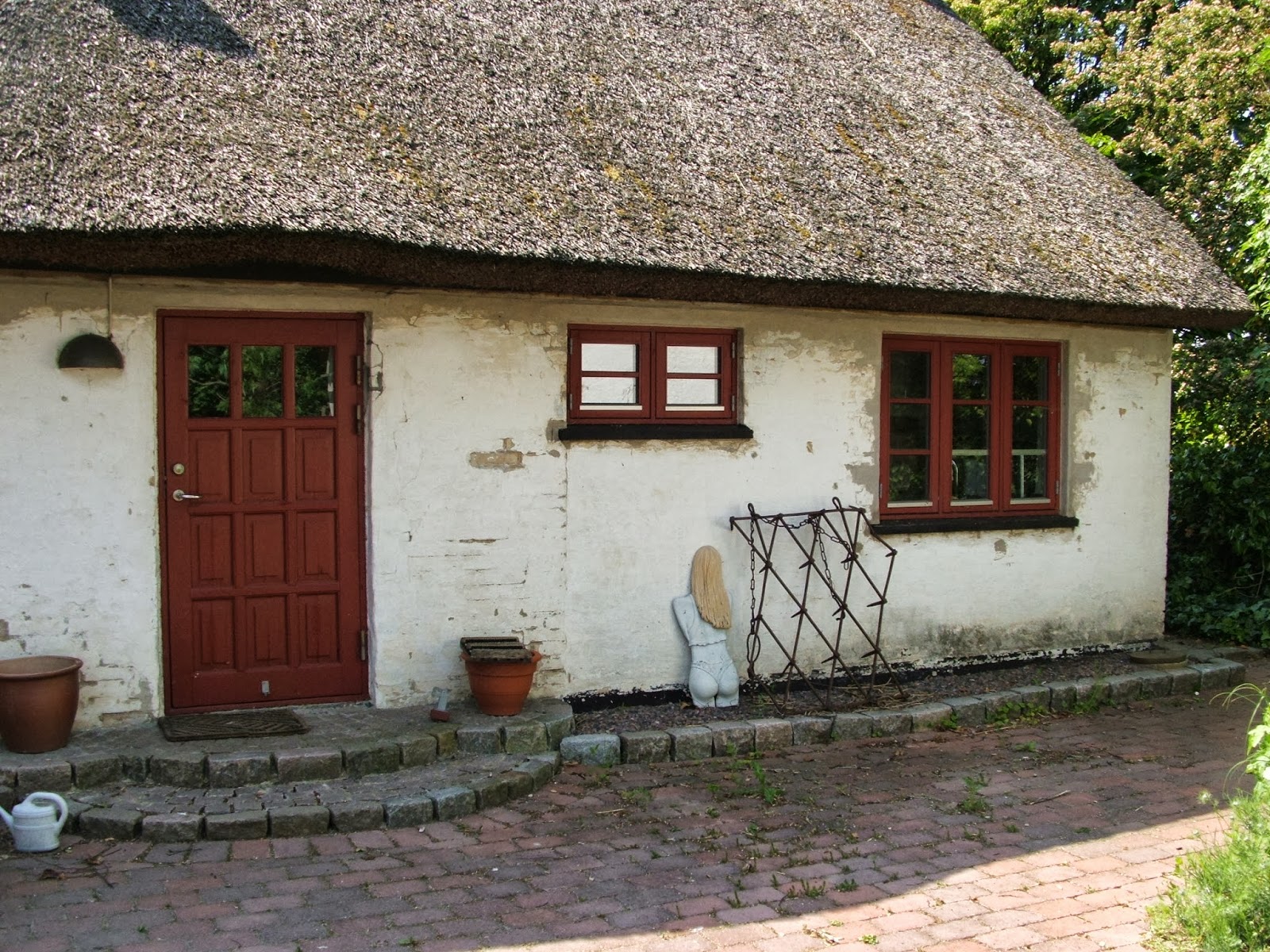
It looked just as I remembered, not having been there since 1975.
 
      Mormor and morfar have long since left this life, first morfar and a few years later mormor, and I do not know who lives in the house now because there was nobody home. Why do I have such good memories from this place? For a number of reason; first it is on a little travelled lane, second there were farm animals, third there were plenty of berry bushes as a windbreak, fourth there was forest within 150 meters, and in this forest was an old Viking grave which had been excavated.
     
      I remember waking up in the mornings to two very distinct sounds, not counting the rooster. The sound of the birds and the wind in the trees, but also of mormor pumping pressure into the tank of her kerosene stove. Yes, the house had no electricity, it had kerosene lamps, a kerosene stove as well as a wood burning stove, it had no indoor plumbing but a well with a good old fashioned hand pump and each morning Max and I would go out and pump two buckets of water. Then we would have a great breakfast of something. Dinner was almost always followed by Æbleskiver, mormor simply made the best. Here is the link so you should try them. http://en.wikipedia.org/wiki/%C3%86bleskiver

 
     We would spend each day exploring the forest, or riding our bicycles to Peters Wharf and row the boat there, or visit my Aunt Ruth and Uncle Frederik, as well as help mormor and morfar. We would be tasked with moving the cows once or twice a day so the grass would have a chance to grow taller.
One other memory of this location is the outhouse, which was a "two seater" and the toilet paper was yesterdays news paper and magazines. One always hoped that the paper was not glossy. They had an old RCA Victrola which we had great fun with, including the old wax records which made fantastic Frisbee's but they didn't generally survive the landing. The first summers we visited our "morbror" (mothers brother) still lived at home, since he was only about 5 or 6 years older than us. He later joined the airforce so we had the place to ourselves.
The kitchen window is on the right, and I assume the other smaller
window is also to the kitchen but I can't remember.
 
      Since the place was empty we went off to find the old Viking grave in the forest but didn't find it. It appears that my memory was a bit off. We did hike down the forest lane and at one point was a strange sound coming from the side of the road but we didn't see anything so we kept going. What we did find was the hill we would snow ski on and learn how to turn, after the school of hard knocks had me run into a tree. The forest had been seriously damaged by heavy winds in the late 1970's and a great deal of it was knocked down but it is making a comeback. The last time it suffered seriously was during winter of 1941 (during WWII). It was a very severe winter and the sap would freeze in the trees and make the crack. Mormor and morfar, as well as my mother, would tell us of the large "cannon fire" like sounds and they were always concerned the Germans occupying that part of Denmark were busy shooting at somebody, but it was the trees simple splitting as the sap expanded when freezing.
 Not the Viking grave hill, but a hill never the less.
We snow skied down this hill on Uncle's skies.
 
     On the way back to the car we decided to check the source of the strange sound, and as we got really close we heard it again; it was a little fawn calling for its mother, and Norma told me we better get out of there because "mom" might just be upset when she comes back.
The fawn calling for "mom"

Norma walking on the forest lane.
 
     Another day comes to a close. We have seen a lot and had some good visits. Time to go back to Frank and Lone's house.
 
More to follow in the next post.