Although I can't say that I did this I have great admiration for the family that is doing it.
http://www.paddling.net/articles/feature.html?show=175&utm_source=FBfeed&utm_medium=socialfeeds

A Chronicle of adventures experienced during canoe trips, camping trips, fishing trips and other travel excursions by a member of the "geritol set" or as some said, by an "old geezer", with occasional detours to my vegetable garden and to my kitchen because I like to cook.
Wednesday, May 6, 2015


Thursday, January 15, 2015
Mexico - Vera Cruz - the first story.
I began writing this post in October of 2014, but was interrupted by a tremendous amount of work, which continues. It is now the middle of January 2015 (Happy New Year to all). Post will continue as time allows.
My first time in Mexico, sometime in 1963, was in the industrial city of Coatzacoalcos in the State of Veracruz. I have to admit that I was not impressed. My perspective was that of a North European and I clearly recall thinking, what a dumpy place this is. In the same breath I have to share that my first impression of the United States was in like manner.
First to the first impression of the US. Arriving for the first time, sometime in late 1961, in the Port of Boston, passing by Logan Airport and then what I believe to be East Boston. Here is what I saw; houses built out of wood, some in sore need of painting, trash cans on the streets, trash on the streets, a general look of neglect and poverty. Surely that can't be true in this country where Hollywood is telling the world, through movies, that everyone is well off, and where Radio America is telling the world the exact same thing. This is during the days of the "cold war" and we knew of course that the Russians (Soviets) were lying because the rosy pictures painted by their propaganda radio broadcasts of the Soviet Union was what we believed the US to be like, and here, in front of my, as we sailed slowly by East Boston, was a stark contrast to what we had come to believe.
Now back to Coatzacoalcos which means "where the snake hides".
http://en.wikipedia.org/wiki/Coatzacoalcos
As with all ports in the world, except one, it is located in an industrial part of the city. But the city had the smell of raw sewage about it. The waters in the port were full of trash and had a very heavy sheen of oil floating on the surface. Going ashore all the buildings looked like they were in need of some serious repair, probably not having been maintained since the last Spaniard in the area died.
From Coatzacoalcos we sailed to the City of Veracruz, meaning "True Cross", from which the State of Veracruz takes its name. What a contrast to Coatzacoalcos!!
http://en.wikipedia.org/wiki/Veracruz,_Veracruz
The port is located downtown; one walks out the gate and after just a block or two one is in the historical center of the city. The Palacio Municipal at one end of the square,
https://es.foursquare.com/v/palacio-municipal-de-veracruz/4d3d93cafb4c54813e49de14
the Cathedral on one side http://en.wikipedia.org/wiki/Cathedral_of_Veracruz
and hotels and restaurants on the other two sides (the link below is in Spanish). This area is called the Portales.
http://aguapasada.wordpress.com/2012/02/29/los-portales-de-veracruz-fundados-en-1595/
Over the next 1 1/2 years I was in Vera Cruz about every 8 to 9 weeks, sailing on the same ship. Over time I feel "in love" with the place, its history and its "alma" (soul). In those days there were no McDonalds, Papa Johns, Office Depot, Wallmart or similar in Vera Cruz. South of the city was a nice area of beach with a number of restaurants and clubs. One of those clubs catered to the elite of the area and every Friday and Saturday night one of, or perhaps back then, the only radio station in the area transmitted live the dance music played by the big orchestra in this particular club.
Further down the down coast is the community of of Boca del Rio (Mouth of the River). In the early 60's it was a fishing community. I remember seeing fishermen in dug outs fishing along the river. http://en.wikipedia.org/wiki/Boca_del_R%C3%ADo,_Veracruz
When we were in port the evenings consisted of taking a taxi to the beach, going swimming in the warm waters. Having a "cuba libre" in one of the places along the beach and then going to Los Portales to listen to the musicians there, or take in one of the performances on the open air stage with groups like "Alma de Veracruz". A group that played old music particular to that region of Mexico.
http://en.wikipedia.org/wiki/Danz%C3%B3n
Now, when travelling from Vera Cruz to Boca del Rio, one can't tell where one ends and the other begins.
Other attractions in Vera Cruz include the Paseo el Malecon, San Juan de Ullua, Veracruz Aquarium, the house of Agustin Lara (a famous composer)
http://www.tripadvisor.com/LocationPhotoDirectLink-g150804-d273690-i78453051-Malecon-Veracruz_Central_Mexico_and_Gulf_Coast.html
http://en.wikipedia.org/wiki/San_Juan_de_Ul%C3%BAa
http://www.tripadvisor.com/Attraction_Review-g150804-d153488-Reviews-Aquarium_of_Veracruz-Veracruz_Central_Mexico_and_Gulf_Coast.html
The following link is in Spanish http://www.acuariodeveracruz.com/
http://en.wikipedia.org/wiki/Agust%C3%ADn_Lara
https://www.youtube.com/watch?v=96NzAzGIWoI
When we return we will have some photos of the places visited. Happy 2015 to all.
My first time in Mexico, sometime in 1963, was in the industrial city of Coatzacoalcos in the State of Veracruz. I have to admit that I was not impressed. My perspective was that of a North European and I clearly recall thinking, what a dumpy place this is. In the same breath I have to share that my first impression of the United States was in like manner.
First to the first impression of the US. Arriving for the first time, sometime in late 1961, in the Port of Boston, passing by Logan Airport and then what I believe to be East Boston. Here is what I saw; houses built out of wood, some in sore need of painting, trash cans on the streets, trash on the streets, a general look of neglect and poverty. Surely that can't be true in this country where Hollywood is telling the world, through movies, that everyone is well off, and where Radio America is telling the world the exact same thing. This is during the days of the "cold war" and we knew of course that the Russians (Soviets) were lying because the rosy pictures painted by their propaganda radio broadcasts of the Soviet Union was what we believed the US to be like, and here, in front of my, as we sailed slowly by East Boston, was a stark contrast to what we had come to believe.
Now back to Coatzacoalcos which means "where the snake hides".
http://en.wikipedia.org/wiki/Coatzacoalcos
As with all ports in the world, except one, it is located in an industrial part of the city. But the city had the smell of raw sewage about it. The waters in the port were full of trash and had a very heavy sheen of oil floating on the surface. Going ashore all the buildings looked like they were in need of some serious repair, probably not having been maintained since the last Spaniard in the area died.
From Coatzacoalcos we sailed to the City of Veracruz, meaning "True Cross", from which the State of Veracruz takes its name. What a contrast to Coatzacoalcos!!
http://en.wikipedia.org/wiki/Veracruz,_Veracruz
The port is located downtown; one walks out the gate and after just a block or two one is in the historical center of the city. The Palacio Municipal at one end of the square,
https://es.foursquare.com/v/palacio-municipal-de-veracruz/4d3d93cafb4c54813e49de14
the Cathedral on one side http://en.wikipedia.org/wiki/Cathedral_of_Veracruz
and hotels and restaurants on the other two sides (the link below is in Spanish). This area is called the Portales.
http://aguapasada.wordpress.com/2012/02/29/los-portales-de-veracruz-fundados-en-1595/
Over the next 1 1/2 years I was in Vera Cruz about every 8 to 9 weeks, sailing on the same ship. Over time I feel "in love" with the place, its history and its "alma" (soul). In those days there were no McDonalds, Papa Johns, Office Depot, Wallmart or similar in Vera Cruz. South of the city was a nice area of beach with a number of restaurants and clubs. One of those clubs catered to the elite of the area and every Friday and Saturday night one of, or perhaps back then, the only radio station in the area transmitted live the dance music played by the big orchestra in this particular club.
Further down the down coast is the community of of Boca del Rio (Mouth of the River). In the early 60's it was a fishing community. I remember seeing fishermen in dug outs fishing along the river. http://en.wikipedia.org/wiki/Boca_del_R%C3%ADo,_Veracruz
When we were in port the evenings consisted of taking a taxi to the beach, going swimming in the warm waters. Having a "cuba libre" in one of the places along the beach and then going to Los Portales to listen to the musicians there, or take in one of the performances on the open air stage with groups like "Alma de Veracruz". A group that played old music particular to that region of Mexico.
http://en.wikipedia.org/wiki/Danz%C3%B3n
Now, when travelling from Vera Cruz to Boca del Rio, one can't tell where one ends and the other begins.
Other attractions in Vera Cruz include the Paseo el Malecon, San Juan de Ullua, Veracruz Aquarium, the house of Agustin Lara (a famous composer)
http://www.tripadvisor.com/LocationPhotoDirectLink-g150804-d273690-i78453051-Malecon-Veracruz_Central_Mexico_and_Gulf_Coast.html
http://en.wikipedia.org/wiki/San_Juan_de_Ul%C3%BAa
http://www.tripadvisor.com/Attraction_Review-g150804-d153488-Reviews-Aquarium_of_Veracruz-Veracruz_Central_Mexico_and_Gulf_Coast.html
The following link is in Spanish http://www.acuariodeveracruz.com/
http://en.wikipedia.org/wiki/Agust%C3%ADn_Lara
https://www.youtube.com/watch?v=96NzAzGIWoI
When we return we will have some photos of the places visited. Happy 2015 to all.
Tuesday, October 7, 2014
ROOTS - not the movie - 19
The last couple of days in Denmark have been busy; my niece Nina is getting married so Nina and her parents are busy with plans and getting things together. Finally the big day arrives and we all drive to a hotel in the town of Randers
http://en.wikipedia.org/wiki/Randers
http://www.globosapiens.net/travel-information/Randers-1770.html
and check into Hotel Randers http://www.hotels.com/ho194372/hotel-randers-randers-denmark/ where the dinner and dance will take place tomorrow evening.
After unpacking and doing away with the "dust" of the journey at the hotel bar we go around town a bit to sight see. My last time in Randers was the spring of 1962 while I was on the good DFDS ship Oklahoma. It is an old city with a lot of history.
http://www.visitranders.com/ln-int/randers/visitranders
Among the points of interest is Saint Mortens (Martin) Church http://www.spottinghistory.com/view/3125/st-mortens-church/
http://urd.dk/sct-morten/short.htm
We came across an old pharmacy, or should I say a really old Apothecary, and there are very few of those around in the modern world today. In this country, the US, they are generally known as Compounding Apothecaries. It is a good example of history on that side of the Atlantic and history on this side of the Atlantic. Here the news casters on Television will use phrases like "Way back in August ..." and now it is almost October. This apothecary is 380 years old, really from "way back .."
As can be seen the apothecary was founded in 1634, and 142 years later the American Colonies declared independence from British rule.
http://en.wikipedia.org/wiki/Randers
http://www.globosapiens.net/travel-information/Randers-1770.html
and check into Hotel Randers http://www.hotels.com/ho194372/hotel-randers-randers-denmark/ where the dinner and dance will take place tomorrow evening.
After unpacking and doing away with the "dust" of the journey at the hotel bar we go around town a bit to sight see. My last time in Randers was the spring of 1962 while I was on the good DFDS ship Oklahoma. It is an old city with a lot of history.
http://www.visitranders.com/ln-int/randers/visitranders
Among the points of interest is Saint Mortens (Martin) Church http://www.spottinghistory.com/view/3125/st-mortens-church/
http://urd.dk/sct-morten/short.htm
We came across an old pharmacy, or should I say a really old Apothecary, and there are very few of those around in the modern world today. In this country, the US, they are generally known as Compounding Apothecaries. It is a good example of history on that side of the Atlantic and history on this side of the Atlantic. Here the news casters on Television will use phrases like "Way back in August ..." and now it is almost October. This apothecary is 380 years old, really from "way back .."
 |
| This was actually directly across the street from the hotel. |
Some participants in the wedding plans were getting their hair done, others were buying last minutes needed stuff.
 |
| One of the stores where we shopped. |
 |
| He just had his hair cut and fixed up really nice. |
 |
| A crucifix made of driftwood. This is located inside of Saint Mortens Church. |
 |
| The bride Nina and the groom Carsten after the wedding. And it began to rain. |
So rain drops are falling from the sky, well, why not add a little challenge to the situation;
The antique automobile hired to transport the newlyweds to the hotel wouldn't start but eventually it was persuaded to do what it was asked to do.
Just a few more photos from the wedding.
http://en.wikipedia.org/wiki/Guden%C3%A5
A great trip to my roots comes to an end. The memories will always be there.
In the near future we will go to Mexico.
The antique automobile hired to transport the newlyweds to the hotel wouldn't start but eventually it was persuaded to do what it was asked to do.
 |
| Make sure they do not get wet. |
 |
| The cranky old engine "cranked" up. |
 |
| The newlyweds and well wishers. |
 |
| The flower girl. |
 |
| The Groom and Bride |
 |
| The young lad enjoying the day. |
 |
| Max on the left, Frank in the middle and yours truly to the right. |
 |
| The bride and her sister. |
 |
| Berith, Nina and Carsten |
 |
| The children with their mother. |
 |
| The obligatory shot of the newlyweds cutting the cake. |
 |
| The Bride |
 |
| The parents oft the Bride. |
 |
| The parents of the bride and groom. |
 |
| Proper table settings, no paper plates or pastic ware. This is way beyond Fajitas, Rice and Beans and Bud Ligth, in other words, it is done correctly. |
 |
| A tender moment between Uncle (Farbror) and the bride. |
 |
| Uncle (Farbror) and bride. |
 |
| Dancing the Wedding waltz |
 |
| She is dancing, I am trying. |
Thus endedth the wedding. Tomorrow is departure day and we had a nice brunch in the home of the young couple. Then it was time for a few last photos and off to the airport for the flight to Copenhagen (København) where we will spend the night until our early flight back to New York and then Houston.
 |
| The newlyweds on the back porch. |
 |
| Add caption |
 |
| Norma enjoying a bit of rain, the first we saw in our three weeks in Denmark. The Gudenaa (Guden River) can be seen in the background. |
 |
| More rain. |
 |
| My brother Max (on the right) and yours truly (on the left). This is the last photo taken in Denmark. |
In the near future we will go to Mexico.
Saturday, August 23, 2014
ROOTS - not the movie - 18
Today, again a bit more than 7 years ago, was a day of leisure, without planned activities during the day. It was also a typical Danish summer day.
We mostly just cooled our heels but did walk around the little town of Nr. Nissum Seminarie By. My brother and his wife were busy running around getting stuff ready for Saturday, because on Saturday my niece Nina is getting married. I recall going with Max to the local car wash where I purchased the DK stickers that are on my car. DK is the internationally recognized abbreviation for Danmark. Remember, it is Danmark, not Denmark, the people are Danes, not Denes. I did purchase a fair supply of them knowing they are made for the North European climate (see temperature gage above) and not the Texas sun and heat. In this heat they do not last more than a year or so, and I only have two left.


 |
| This photo is from about 11 AM (11:00) |
Later in the day we went to my niece Beriths house and spent a little time there, and walked around the bay which is on the Limfjord. Here we encountered an authentic replica of a viking ship, as well as a play area for the kids made like a viking ship.
 |
| We are coming to conquer your lands and your people. |
 |
| Authentic descendants of the Vikings |
 |
| The viking ship in silhouette as the sun is almost setting. |
 |
| The finely carved figure head. |
 |
| The interior of the hull with the thwarts clearly visible. |
 |
| Imagine crossing oceans in something like this! All the way to New Foundland and back!! |
 |
| Mast and rigging detail. |
 |
| This gives whole new meaning to the term "to go in Vik", that is to go in search of, to go exploring. |
This particular boat was used in a trip across the North Sea to England and back, and I am sure the present residents around Lindisfarne had a much better understanding of the panic that gripped the area a bit more than 1000 or so year ago when they saw a fleet of viking ships come up over the horizon. Below are a number of links of those historic events as well as more information.
This evening I also got to enjoy another "Jolly Cola", the first coke type drink I ever had, at about the age of 9 which means it had to be sometime in 1954.
 |
| My first coke type drink was a Jolly Cola. |
There is a ferry landing right where my niece lived, and the little park was made for people waiting for the ferry.
 |
| The ferry just left the landing. Notice the correct color fishing boat far left. |
One of the hazards of living near the ocean, especially when it is almost on your doorsteps, is the fact that you will have the constant company of seagulls, and their droppings on just about everything.
 |
| This almost looks like a mad artists rendition of an island with sandy beaches, on the left, and mountains on the right, in a mighty blue ocean or perhaps a view from space. |
A walk along the beach of the North Sea and another Viking grave were the last activities of the day.
 |
| A Viking grave |
In the next post will be a few pictures from our last two days in Denmark.
Tuesday, August 12, 2014
ROOTS - not the movie 17
We have only a few days left in Denmark and there are many things to see and do. Today (again this was a bit more than 7 years ago) we are going to some caves where cheese is stored for proper aging and we are also going to go back in Danish history about 150 to 200 years so.
First to Mønsted Limestone Caves, bring a coat, as it is a bit on the chilly side underground. All of the links are in English unless noted otherwise.
http://www.monsted-kalkgruber.dk/en/attractions/the-great-caves
http://www.monsted-kalkgruber.dk/en
http://www.strahlen.org/vp/dk/monsted/monsted.php
http://www.bing.com/images/search?q=moensted+limestone+cave&qpvt=moensted+limestone+cave&FORM=IGRE
The articles following here is copied from www.gearthacks.com
Description: When the Danes became Christians more than 1000 years ago, a new extra source of income was created, "Limestonework and limeburning". With the new religion churches followed which were built of stone. The stone was held together using burnt limestone slaked to mortar, a new building material in Denmark at that time.
Under Mønsted a limestone mountain was found. The limestone which was earlier a useless stone now became a source of income. In the space of 200 years more than 2000 churches were build, equalling 10 a year. This building activity gave Mønsted it's start in the limestone industry, which ended finally in 1978.
Mønsted is only 14 kilometres from the town of Viborg, which in the middel ages was known as the "Capital of Jutland". Along with it`s cathedral there were 12 churches, convents, monasteries and many houses. A bishop who was willing to build and rich citizens meant that Mønsted always had costumers for the burnt limestone, which meant a steady production from the mine. In the sixteen hundreds when Viborg experienced a depression, the limestone production carried on. Mønsted had long before found new markets elsewhere. In 1860 when production was at it`s peak, there were about 3000 loads of burnt limestone delivered to customers all over Jutland from Mønsted and Daugbjerg.
In 1872 the farmers sold all the rights of limestone to the industry "Mønsted Kalkværker" which later became a part of "De jydske Kalkværker". The limestone was no longer only used for mortar. The metal industry and the chemical industry also bought the limestone and the agricultural industry used the limestone for the fields. Even the worst limestone was for sale, and the once before useless rocks of flint were used as fillings in streets, foundations and brickwork. The limestoneproduction was now full time work throughout the year. During winter people worked in the caves and during summer in the open limestone quarry. Despite the use of wagons and hoists, the limestone was still hewed with hoes.
In 1953 the work in the caves ended and two years later also in the limestone quarry, but the limekiln continued to burn limestone from Djursland untill 1978.
There are 200 tons of cheese in Mønsted Limestone Caves. The cheese is from a small dairy in the town of Vellev. After being brought here the cheese spends 8 weeks maturing in the caves. The cheese is turned once every week. The air humidity of 98% and a temperature of 8 degrees create perfect conditions for the maturing of the cheese. Most of the cheese is exported to Germany where it can be bought as "Cavecheese". You can also buy the cheese in the kiosk here in Mønsted Limestone Caves. This is perhaps the best souvenir you can get from a visit to Mønsted Limestone Caves. end
It was definitely on the cool side, but not just temperature wise, in the caves. It was very interesting to see these massive man made tunnels underground. This work took place over almost 900 years. Unfortunately, the section where the cheeses were stored was closed to the public due to some maintenance work, so we didn't get to sample.
Here are our photos from that "under the earth" excursion.
With the average temperature under ground being 8 deg. C / 46.4 deg. F the camera batteries bit the dust, and we were not able to take any more photos. I have always chuckled at the requirement to wear hardhats in such places. If the caves were to collapse the hats would be of no use whatsoever, not even for body identification purposes, however, they do offer a bit of protection in case of small pieces dropping off of the ceiling.
We stopped into one other little shop in the Old Town but for some odd reason I do not have any photos from that one. We were greeted by a young lady in period costume who handed us each a glass of water and a piece of Danish pumpernickel bread with lard and salt, which was the custom in the old days.
Since were were speaking English among ourselves I made the comment that this is really good for the arteries, particularly if one suffers from a bad cholesterol problem. The young lady, representing her time period which was probably in the middle 1600's said to us, in English "We don't have that problem". I am sure she was right since in those days people did hard physical work and burned off the fat, and in those days no one had ever heard of cholesterol.
At the end of the day we meet my brother Max, my sister in law Mariann at a restaurant for dinner after waling along the North Sea (Nord Soen) a bit. It is here that we have another restaurant situation;
So we had a nice dinner and when it came time to pay I paid, with my American Credit Cards, which was accepted. When the ticket was brought to the table I mentioned there was not place to add a tip to which the waitress replied "I don't need your tip, Sir. In this country we receive proper pay for the work done and do not have to depend on the handouts of others". Well, excuse me - I find the statement very much to the point but also a bit ironic as a large percentage of the Danish population receive very generous benefits under the "welfare" system in place, which is in fact "handouts of others" , albeit mandatory handouts since the funds are generated in the form of taxes.
Another good day comes to an end.
More to follow in the next post.
First to Mønsted Limestone Caves, bring a coat, as it is a bit on the chilly side underground. All of the links are in English unless noted otherwise.
http://www.monsted-kalkgruber.dk/en/attractions/the-great-caves
http://www.monsted-kalkgruber.dk/en
http://www.strahlen.org/vp/dk/monsted/monsted.php
http://www.bing.com/images/search?q=moensted+limestone+cave&qpvt=moensted+limestone+cave&FORM=IGRE
The articles following here is copied from www.gearthacks.com
Description: When the Danes became Christians more than 1000 years ago, a new extra source of income was created, "Limestonework and limeburning". With the new religion churches followed which were built of stone. The stone was held together using burnt limestone slaked to mortar, a new building material in Denmark at that time.
Under Mønsted a limestone mountain was found. The limestone which was earlier a useless stone now became a source of income. In the space of 200 years more than 2000 churches were build, equalling 10 a year. This building activity gave Mønsted it's start in the limestone industry, which ended finally in 1978.
Mønsted is only 14 kilometres from the town of Viborg, which in the middel ages was known as the "Capital of Jutland". Along with it`s cathedral there were 12 churches, convents, monasteries and many houses. A bishop who was willing to build and rich citizens meant that Mønsted always had costumers for the burnt limestone, which meant a steady production from the mine. In the sixteen hundreds when Viborg experienced a depression, the limestone production carried on. Mønsted had long before found new markets elsewhere. In 1860 when production was at it`s peak, there were about 3000 loads of burnt limestone delivered to customers all over Jutland from Mønsted and Daugbjerg.
In 1872 the farmers sold all the rights of limestone to the industry "Mønsted Kalkværker" which later became a part of "De jydske Kalkværker". The limestone was no longer only used for mortar. The metal industry and the chemical industry also bought the limestone and the agricultural industry used the limestone for the fields. Even the worst limestone was for sale, and the once before useless rocks of flint were used as fillings in streets, foundations and brickwork. The limestoneproduction was now full time work throughout the year. During winter people worked in the caves and during summer in the open limestone quarry. Despite the use of wagons and hoists, the limestone was still hewed with hoes.
In 1953 the work in the caves ended and two years later also in the limestone quarry, but the limekiln continued to burn limestone from Djursland untill 1978.
There are 200 tons of cheese in Mønsted Limestone Caves. The cheese is from a small dairy in the town of Vellev. After being brought here the cheese spends 8 weeks maturing in the caves. The cheese is turned once every week. The air humidity of 98% and a temperature of 8 degrees create perfect conditions for the maturing of the cheese. Most of the cheese is exported to Germany where it can be bought as "Cavecheese". You can also buy the cheese in the kiosk here in Mønsted Limestone Caves. This is perhaps the best souvenir you can get from a visit to Mønsted Limestone Caves. end
It was definitely on the cool side, but not just temperature wise, in the caves. It was very interesting to see these massive man made tunnels underground. This work took place over almost 900 years. Unfortunately, the section where the cheeses were stored was closed to the public due to some maintenance work, so we didn't get to sample.
Here are our photos from that "under the earth" excursion.
 |
| Norma and I in one of the cave sections. |
 |
| In another section |
 |
| My niece Nina and Norma |
Back out into daylight and then on to Aarhus and the Old Town of Aarhus. Back in my seafaring days I had been to Aarhus, or as it is also spelled in Danish Århus, a number of times but that was back in the early 60's, in other words, about 45 years ago. Århus is the second largest city in Denmark. Here are a number of links with good information;
and there is a lot more available so just google Aarhus.
Aarhus is also famous for its Cathedral and it dates back to the beginning of the 13th century, or from a time about 290 years before Christopher Columbus arrived in the New World, just to put things into perspective.
Unfortunately we didn't make it to the cathedral.
The Old Town was a surprise to me, a welcome surprise I must say. It was delightful to see history restored and preserved in such a fine fashion.
Again a google search for Old Town Aarhus or Old City Aarhus will provide many links.
Here are some of our photos from that afternoon. This was also the first time, after almost three weeks in the Denmark, that we saw a piece of trash on the street, in this case an empty cigarette pack.
 |
| Nina and Norma posing in front of an impressive three story building. |
 |
| Norma on the second floor balcony. |
 |
| A close up |
 |
| Interesting style, a balcony with a turn in it. |
 |
| Do you think that is enough firewood for the winters? |
 |
| Norma say she likes the second floor better. |
 |
| My Danish ancestors were a welcoming people. The sign on the wall says (translated) Outpouring of Beer and Wine |
 |
| Inside a wood working shop. Here oak barrels are made. |
 |
| In the grocery store |
 |
| Taking a needed rest in the Old Harbour were the Viking ships used to tie up. |
 |
| Norma is checking the laundry. |
Since were were speaking English among ourselves I made the comment that this is really good for the arteries, particularly if one suffers from a bad cholesterol problem. The young lady, representing her time period which was probably in the middle 1600's said to us, in English "We don't have that problem". I am sure she was right since in those days people did hard physical work and burned off the fat, and in those days no one had ever heard of cholesterol.
At the end of the day we meet my brother Max, my sister in law Mariann at a restaurant for dinner after waling along the North Sea (Nord Soen) a bit. It is here that we have another restaurant situation;
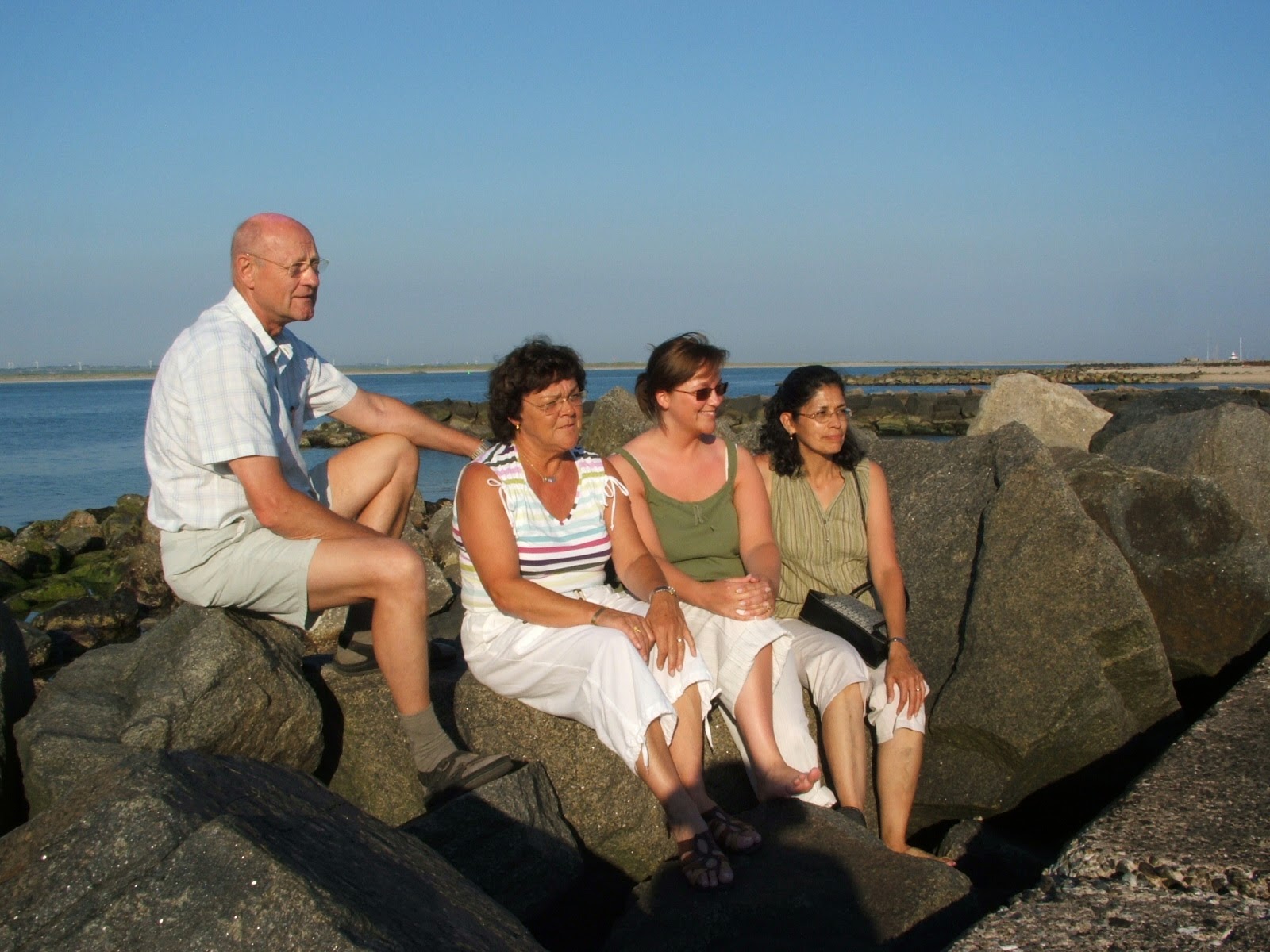 |
| Max, Mariann, Nina and Norma |
 |
| Yours truly. |
 |
| Norma enjoying the cool waters of the North Sea. |
 |
| Come on in, the water is fine. |
 |
| Once a farrier, always a farrier. He is actually removing stones from the shoe sole. |
Another good day comes to an end.
More to follow in the next post.
Subscribe to:
Posts (Atom)